What makes us different
The county has never been inside your house.
Your appraisal district values hundreds of thousands of homes a year. They do it with a model: recent sales near you, your square footage, your lot, the year it was built. Nobody walks through. Nobody looks at the roof.
That’s not a criticism of them. It’s arithmetic. There is no version of this where somebody visits every house in the county.
So your house gets valued as if it’s in average condition for its age.
That’s how mass appraisal works, and the districts publish it. Every home gets a condition rating and an assumed age, and the model deducts wear and tear from there. With nobody inside, the rating lands on average.
If your house is genuinely average, that’s fine and there’s nothing to argue about. If it isn’t, you’re paying tax on a house you don’t own.
What the appraisal district uses
- Sales of nearby homes
- Square footage
- Lot size
- Year built
- Neighborhood classification
What we look at as well
- Roof age and remaining life
- Foundation movement
- HVAC at end of service life
- Plumbing and electrical condition
- Drainage and grading
- Deferred maintenance throughout
Two identical houses. Two very different houses.
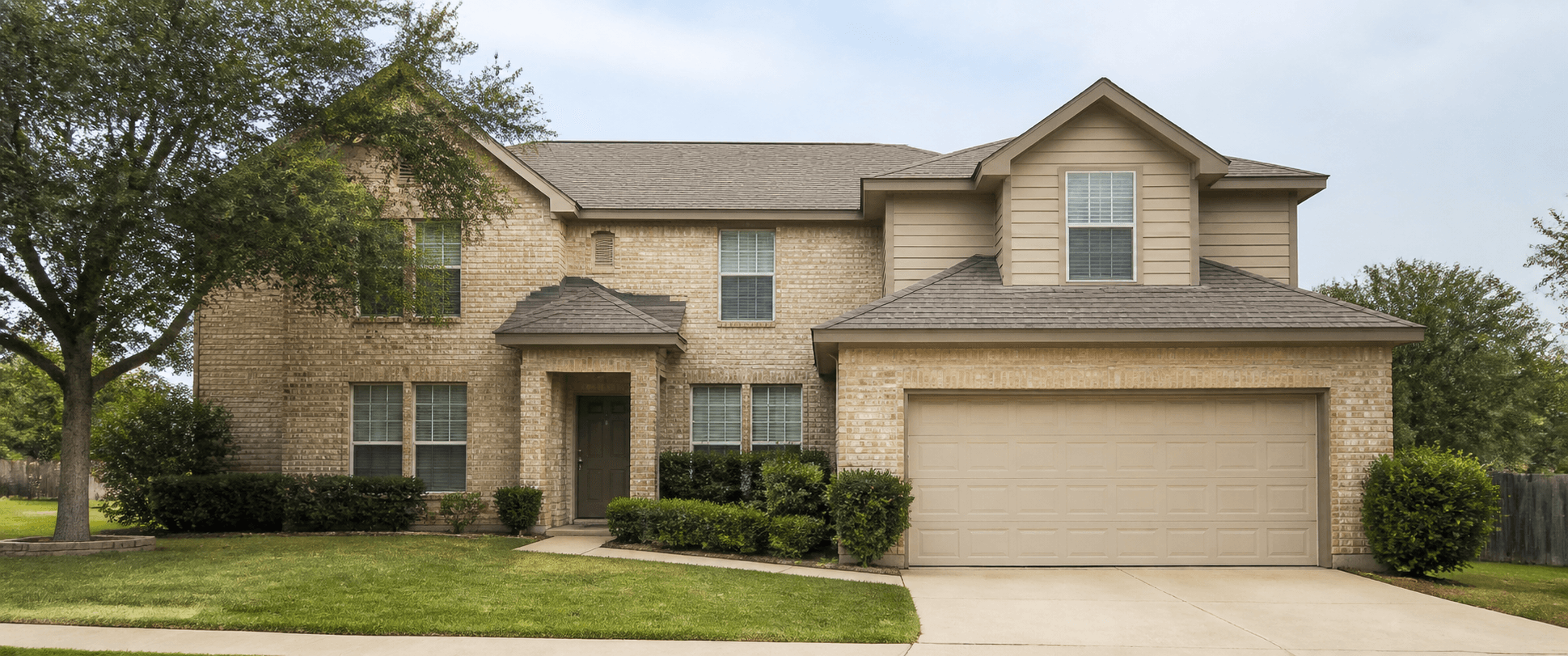
House A
Same street, same year, same square footage. Roof replaced last year, foundation sound, systems recent.
County value: $438,000
House B
Roof at the end of its life. Foundation movement documented. HVAC nineteen years old.
County value: $438,000, the same
The model can’t tell these two apart. Somebody has to bring it the difference. That’s the job.
Texas law is on your side here. It just needs somebody to show up.
The Tax Code says each property has to be appraised on the individual characteristics that affect its market value, and that all available evidence specific to your property has to be taken into account. When the district compares your home to others, condition is one of the things the law names.
None of that helps if nobody brings the evidence. And in a protest, the appraisal district carries the burden of proof, not you. We don’t have to prove the perfect number. We have to show theirs doesn’t hold up.
Texas Tax Code §§23.01(b), 23.011, 23.013 and 41.43(a).
Where the condition information comes from
Some of it you tell us. Some of it comes from documentation about the property’s condition that already exists by the time we start. Some of it we can see from public records and permit history. We put it together into a summary the district can act on, and we submit that summary on our letterhead, not the underlying documents.